
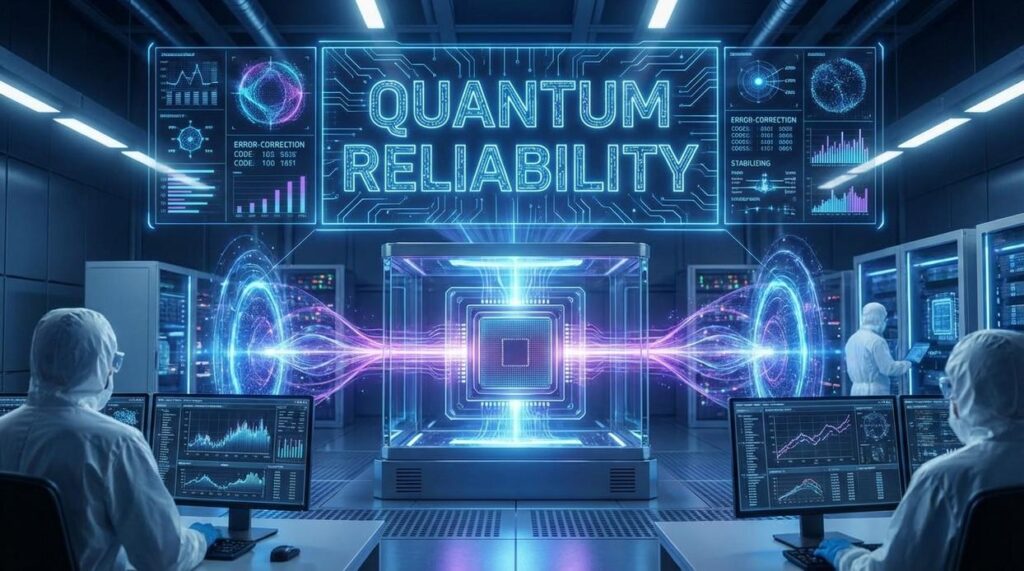
Quantum computing headlines are everywhere—but if you’ve tried to understand what’s actually happening beyond the buzz, you’re not alone in feeling lost.
That’s because most updates drown in hype or get bogged down in theory. But the real action? It’s happening deep in labs and design simulators, where engineers and physicists are solving make-or-break challenges every day.
This article breaks down the current state of quantum computing innovation—what’s real, what’s working, and what’s holding it all back.
We scanned recent research breakthroughs and engineering milestones across the quantum landscape to bring clarity on the areas that matter most: qubit stability, error correction, hardware scalability, and more.
You’ll leave with a grounded understanding of where the frontlines of quantum R&D truly are—and why each breakthrough inches us closer to practical quantum advantage. No buzzwords. Just progress you can track.
The Core Challenge: From Fragile Qubits to Stable Systems
As quantum computing paves the way for unprecedented advancements in technology, it’s essential to explore how these innovations will coexist with the ongoing transformations brought about by remote work tools, which have fundamentally altered tech infrastructure – for more details, check out our The Real Impact of Remote Work Tools on Tech Infrastructure.
Let’s start with the basics—without getting stuck there. Qubits, the quantum version of classical bits, can exist in multiple states at once thanks to superposition. They can also become entangled, meaning the state of one instantly affects another, even at a distance (kind of like the brain-meld from Star Trek, minus the Vulcans). These aren’t just scientific curiosities—they’re the foundations of quantum algorithms that, one day, could model drug interactions, crack encryption, and revolutionize logistics.
But there’s a catch.
Quantum systems are amazingly delicate. The biggest enemy? Decoherence—the phenomenon where even the tiniest environmental “noise” knocks a qubit out of its fragile quantum state. Heat, light, even magnetic fields can corrupt the data. It’s like trying to play Jenga during an earthquake.
So what’s being done? Enter two research pillars working in tandem: First, designing better-quality qubits that resist noise and last longer. Second, creating smarter quantum error correction codes that detect and fix those inevitable slip-ups. These efforts promise massive benefits, from more reliable quantum hardware to running algorithms that actually stay intact long enough to work.
Right now, we’re in the NISQ era—think short-term use, limited precision. But future fault-tolerant quantum systems could unlock breakthroughs in cryptography, global finance, and quantum computing innovation at scale.
Pro tip: Following the right wearable tech trends to watch from health sensors to ar glasses may also give you clues about where consumer-oriented quantum leaps will land next.
R&D in Physical Qubits: The Race for Coherence and Scalability
If you’ve been keeping an eye on quantum computing innovation, you already know: the physical qubit landscape is a battleground of tradeoffs.
Let’s break this down. Superconducting circuits, favored by tech giants like Google and IBM, offer blazing fast gate speeds — a solid pro. But here’s the rub: they need to be kept near absolute zero and are notoriously sensitive to noise (basically, quantum divas). Fortunately, ongoing R&D in materials science and multilayer circuit design is pushing coherence times upward, making these qubits more dependable during calculations.
On the flip side, trapped ions boast long coherence times and exceptionally high gate fidelity. Translation: these qubits are stable and precise. But don’t get too excited — their gate operations are molasses-slow compared to superconductors. Researchers are tackling this by exploring laser-less gate operations and microfabricated traps to enhance scalability and processing speed. (Less lasers, more results.)
And then there’s photonic quantum computing. Instead of particles with mass, we’re talking about photons — tiny packets of light. This method is inherently robust to noise and ideal for transmitting quantum information over long distances. However, scalable systems hit a logistical logjam due to inefficient single-photon sources and detectors. Current R&D is hyper-focused on resolving that, with promising results from integrated photonics.
Emerging contenders like silicon spin qubits and neutral atoms bring exciting potential to the table, especially in manufacturability and density. Though not yet mainstream, early breakthroughs suggest they could play a pivotal role in the long-term roadmap.
Pro Tip: When evaluating qubit technologies, look not just at performance today, but at how easily they can scale in the hardware stack tomorrow.
Software & Algorithms: The Push for Quantum Error Correction (QEC)
Let’s be real—quantum computing isn’t just about futuristic headlines and cool demos. The real challenge? Making qubits reliable enough to do actual work.
Right now, physical qubits (the raw units in a quantum processor) are incredibly error-prone. To overcome this, researchers build logical qubits—stable, virtual units formed from thousands of physical qubits working together. Think of it like combining a bunch of shaky Wi-Fi signals to create one stable connection (in theory, great—until your modem crashes).
The Overhead Problem
Here’s where it gets wild: To create one logical qubit, you might need thousands of physical ones. That’s called qubit overhead, and it’s the bottleneck in scaling up real quantum applications. Until this improves, quantum supremacy isn’t exactly around the corner.
Surface Codes and Alternative Approaches
The surface code is currently the go-to error correction method. It’s stable and well-studied. But it’s also resource-hungry. So, researchers are exploring more compact options like LDPC (Low-Density Parity-Check) codes, which offer hope for drastically reducing the number of required qubits without sacrificing performance.
Enter AI
Yes, machine learning is jumping into the mix. Researchers are applying it to optimize QEC in real time, adjusting to system “noise”—the root cause of most quantum errors.
Pro tip: AI models, like reinforcement learning algorithms, are helping tailor error correction protocols on the fly—essential in noisy systems with variable environments.
This is where quantum computing innovation meets practical engineering. It’s not perfect yet, but it’s getting smarter—literally.
Application-Driven R&D: Where Quantum Will Make an Impact
When people hear “quantum computing,” they often imagine vague sci-fi magic (cue the swirling portals and ominous glowing cubes). But real-world innovation is happening—fueled by one powerful principle: application-driven R&D.
Let’s break it down across the three biggest impact zones—and compare how each one is influencing the course of quantum computing innovation.
| Application Area | How Quantum Helps | Why It Matters Now |
|---|---|---|
| Quantum Chemistry & Materials | Simulates molecular interactions at atomic scales |
Drives drug discovery and battery breakthroughs |
| Cryptography & Security | Shor’s algorithm threatens RSA encryption | Sparks the race for Post-Quantum Cryptography (PQC) |
| Optimization & ML | Algorithms like QAOA and VQE streamline complex systems | Powers logistics, finance, and AI modeling |
So, what’s the difference?
- Chemistry vs. Optimization: Drug modeling needs highly accurate simulations (quantum supremacy doesn’t hurt here). Optimization, though, bets on speed and energy savings—especially for AI workloads in data centers.
- Security vs. Everything Else: While chemistry and ML benefit from quantum, cryptography views it as an existential threat. One aims to harness it; the other aims to survive it.
Pro Tip: If you’re investing time or capital, follow where the algorithm R&D is catching the most funding—it often points to the next leap.
From Research Lab to Real-World Revolution
You came here to understand where quantum computing really is—not just the hype, but the hard science.
We’ve unpacked the breakthroughs that matter: physical qubits getting more stable, error correction evolving fast, and algorithms that are finally starting to connect with real-world problems. These aren’t theories—they’re the building blocks of actual, scalable technology.
You now understand that quantum computing innovation is a long game. But it’s a game already in motion, defined by steady advances that are reshaping what’s technically possible.
Your next move? Stay ahead of the noise: Dive deeper into the R&D shaping the future of quantum computing innovation. Track incremental breakthroughs. Cut through buzzwords.
This is how you position yourself for the coming disruption.
We’re the #1 resource for real-world tech insight—focused, verified, and future-facing.
Don’t fall behind. Sign up for alerts and stay plugged into the breakthroughs that actually matter.
 Ask Cairis Tornhaven how they got into expert insights and you'll probably get a longer answer than you expected. The short version: Cairis started doing it, got genuinely hooked, and at some point realized they had accumulated enough hard-won knowledge that it would be a waste not to share it. So they started writing.
What makes Cairis worth reading is that they skips the obvious stuff. Nobody needs another surface-level take on Expert Insights, Throw Signal Encryption Techniques, Device Troubleshooting Guides. What readers actually want is the nuance — the part that only becomes clear after you've made a few mistakes and figured out why. That's the territory Cairis operates in. The writing is direct, occasionally blunt, and always built around what's actually true rather than what sounds good in an article. They has little patience for filler, which means they's pieces tend to be denser with real information than the average post on the same subject.
Cairis doesn't write to impress anyone. They writes because they has things to say that they genuinely thinks people should hear. That motivation — basic as it sounds — produces something noticeably different from content written for clicks or word count. Readers pick up on it. The comments on Cairis's work tend to reflect that.
Ask Cairis Tornhaven how they got into expert insights and you'll probably get a longer answer than you expected. The short version: Cairis started doing it, got genuinely hooked, and at some point realized they had accumulated enough hard-won knowledge that it would be a waste not to share it. So they started writing.
What makes Cairis worth reading is that they skips the obvious stuff. Nobody needs another surface-level take on Expert Insights, Throw Signal Encryption Techniques, Device Troubleshooting Guides. What readers actually want is the nuance — the part that only becomes clear after you've made a few mistakes and figured out why. That's the territory Cairis operates in. The writing is direct, occasionally blunt, and always built around what's actually true rather than what sounds good in an article. They has little patience for filler, which means they's pieces tend to be denser with real information than the average post on the same subject.
Cairis doesn't write to impress anyone. They writes because they has things to say that they genuinely thinks people should hear. That motivation — basic as it sounds — produces something noticeably different from content written for clicks or word count. Readers pick up on it. The comments on Cairis's work tend to reflect that.