

Most machine learning models look great on paper—until they meet the real world.
You’re here because you’ve seen how quickly model performance can drop once it’s out of the lab. High accuracy in training doesn’t always carry over to production. Why? Because real-world environments shift—data drifts, user behavior changes, and configurations that once worked stop delivering results.
That’s where this guide comes in.
We’re walking you through a full, end-to-end framework for machine learning improvement. From preprocessing raw data to monitoring live models, every step is designed with long-term performance in mind.
We don’t just hypothesize—we’ve deployed, stress-tested, and optimized ML systems in real environments where results matter. That’s how we know what continues to work after the initial model launch—and what quietly fails.
In this article, you’ll learn how to build models that adapt, scale, and keep performing long after deployment.
The Foundation: Data-Centric Optimization Strategies
As machine learning algorithms continuously refine their predictions through data exposure and feedback, the excitement around innovations like Ustudiobytes becomes even more palpable—especially considering its anticipated launch and what it promises to bring to the field – for more details, check out our When Is Ustudiobytes Going To Be Live.
Let me start with a story.
Early in my ML journey, I built what I thought was a flawless fraud detection model. Sleek architecture. Precision loss functions. Hours of hyperparameter tuning. But it completely fell apart in production. Why? Because the training data was riddled with inconsistencies—duplicate records, mislabeled entries, missing context. In short: GARBAGE IN, GARBAGE OUT.
Some say the secret sauce is in state-of-the-art algorithms. I disagree—strongly. You can pour all the transformer magic you want into your code, but if your data is junk, your results will be too (file under: painful lessons).
Here’s what actually moved the needle:
1. Advanced Feature Engineering
Creating interaction terms (like income × purchase frequency), polynomial expansions, and domain-specific transformations made the model “see” relationships it previously ignored. It’s not always about more data—sometimes it’s about better data.
2. Data Augmentation Techniques
Whether augmenting images with flips and rotations, generating synthetic sentences using back-translation, or perturbing tabular values, I found these boosts led to genuine improvements in model generalization—especially on smaller datasets.
3. Handling Imbalanced Datasets
In a class-imbalanced world (think fraud or rare diseases), plain accuracy lies. Using SMOTE to create synthetic minority samples and switching to metrics like F1-score or AUC-PR gave a far more honest picture of performance.
Pro Tip: Don’t just upsample blindly. Analyze feature distributions to avoid synthetic messes.
Ultimately, what worked wasn’t chasing shiny algorithms. It was leaning into a data-first mindset. That’s where machine learning improvement truly begins.
Want to dive deeper into fundamentals that matter? Don’t miss this explainer on supervised vs unsupervised learning key differences explained.
Core Algorithm Tuning and Model Architecture Enhancement
It’s easy to assume that cutting-edge model performance is mostly about gathering more data or adding layers to your neural network. But engineers from Brooklyn’s fintech co-ops to Tokyo’s robotics startups know — it often comes down to strategic tuning and smart architecture decisions.
Take hyperparameter optimization. Some still rely on manual adjustments and intuition (usually paired with too much coffee). But automated methods like Grid Search, Randomized Search, and Bayesian Optimization systematically explore configurations and give you repeatable, scalable results.
Want an edge? Bayesian Optimization uses probability to predict the best next parameter values — like a chess player thinking five moves ahead. In high-stakes verticals like Vancouver’s medical imaging startups or Zurich’s quantitative hedge funds, that accuracy edge can mean millions.
Now let’s talk ensembling. Instead of picking one model, what if you could combine several average-but-different ones into a powerhouse? From Kaggle competitions to natural language processing pipelines in Bangalore, techniques like:
- Bagging (e.g., Random Forests),
- Boosting (e.g., XGBoost, LightGBM),
- and Stacking (layering diverse learners with a meta-classifier),
have shown to outperform lone wolves almost every time.
But don’t overdo it. Model complexity comes with tradeoffs. We call it the bias-variance dilemma: simpler models miss the signal (high bias), overly complex ones chase noise (high variance). The trick? Choose based on your data’s size and noisiness — not your ambition.
Sometimes, what you need is not more trees or better parameters, but an entirely alternative architecture. Traditional CNNs might crumble under language or long-range dependencies. Enter attention mechanisms, residual connections, and other deep-learning game-changers — fueling everything from Norway’s smart grid forecasting to LA’s video personalization platforms.
Here’s your machine learning improvement: smarter algorithms, not just bigger ones.
Optimizing the Training Process for Speed and Efficiency
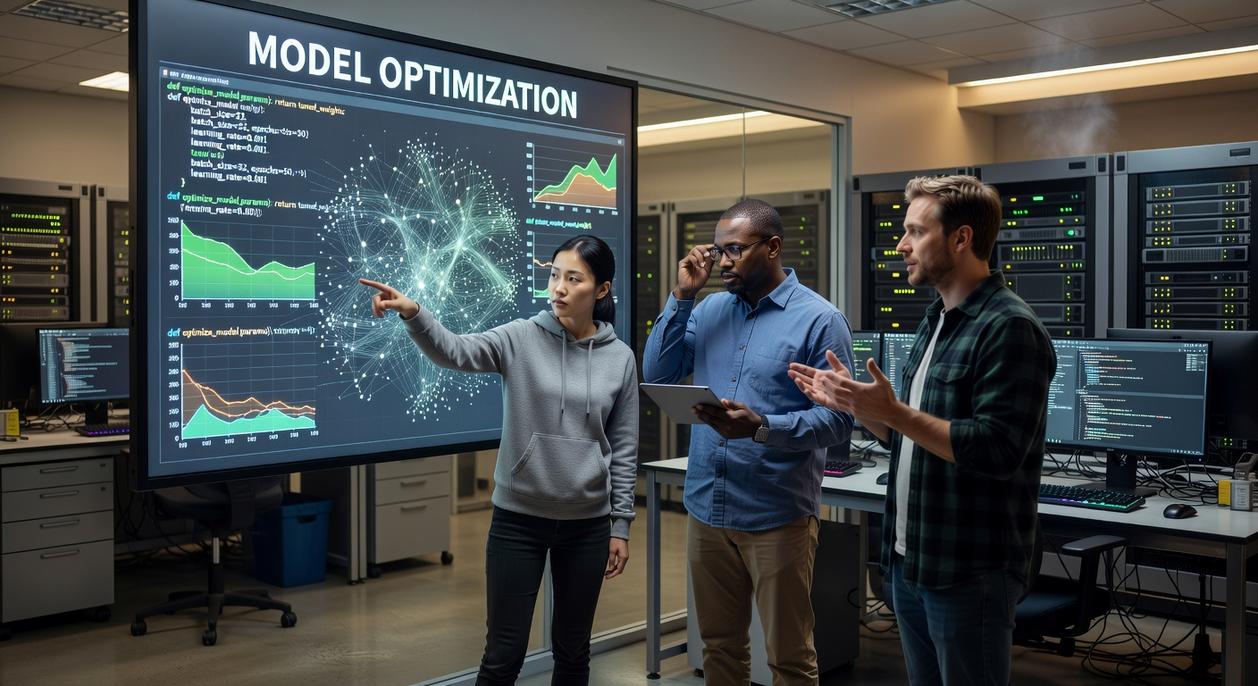
If you’re deep in the model training game, you’ve probably felt the drag—waiting hours (sometimes days) for results that may or may not pan out. But what if you could trade that agony for agility?
Let’s compare some core approaches side-by-side to see what really impacts your training stack.
Hardware Acceleration: GPUs vs TPUs
When it comes to raw power, both GPUs (graphics processing units) and TPUs (tensor processing units) are top picks for model training. GPUs—great for flexibility—are favored in research and development due to their broad library support (think PyTorch, TensorFlow). TPUs, built specifically for tensor operations, often sprint past GPUs in performance per watt for deep learning models, especially on Google Cloud.
Pro tip: If you’re training massive transformer models, TPUs can cut down training time significantly. But for prototyping? Stick with the GPU—you’ll have fewer headaches.
Distributed and Parallel Training: Horizontal vs Vertical Scaling
Training one model across multiple cores (parallelism) is helpful, but spreading your load across multiple machines (distribution) is how you handle datasets too big for a single GPU. Distributed training (like using Horovod or PyTorch’s DDP) lets teams train faster—at scale.
The catch? More setup, more complexity. Still, worth it for enterprise-scale needs.
Quantization vs Pruning
Need to speed things up post-training? Enter quantization (reducing precision of weights) and pruning (removing unimportant parameters). Quantization is better for inference on mobile or edge devices (think voice assistants), while pruning reduces payload. Both lead to leaner models—without major accuracy drops.
(Say goodbye to bloated models eating your RAM.)
Efficient Data Loading: tf.data vs PyTorch DataLoader
Training speed isn’t just about the model—it’s also about feeding data efficiently. TensorFlow’s tf.data API and PyTorch’s DataLoader streamline pre-processing and batching.
While PyTorch fans argue DataLoader is easier to debug, TensorFlow’s pipeline excels under complex augmentation chains.
Bottom line: If your GPU is waiting on the CPU to deliver data, that’s your bottleneck.
Every improvement, from smarter hardware use to leaner model design, contributes to overall machine learning improvement. In fast-moving ML workflows, it’s not just what you train—it’s how efficiently you train it.
Post-Deployment: Continuous Monitoring and Iteration
Most teams stop at deployment. But the best-performing models? They’re the ones that evolve.
Let’s be clear—model staleness is real. And it’s sneaky. You won’t always see drastic drops in accuracy overnight. But over weeks? Months? Performance quietly slips. That’s model drift, and detecting it means tracking shifts in input data or output distribution over time. Tools like KL divergence and population stability index (PSI) help here (yes, acronyms can be life-savers).
Now, some folks rely solely on annual updates. That’s like only sharpening your kitchen knife once a year—and wondering why it won’t slice tomatoes. Establishing a retraining pipeline is critical. Automate model training whenever performance dips below a certain threshold (Pro tip: Use data thresholds, not rigid timelines).
A/B testing for models? Underrated. Routinely testing new versions against production using live traffic helps minimize user disruptions while quietly unlocking machine learning improvement.
The real sleeper edge? A HUMAN-IN-THE-LOOP feedback system. Many ignore it. But continuously feeding corrected predictions from expert review back into training data creates a goldmine of domain-specific refinement most competitors miss.
Treating Model Performance as a Continuous Process
You came here looking for a smarter way to improve your machine learning systems over time—not just during development, but long after deployment.
Too often, teams build a model, ship it, and hope for the best. But without ongoing attention, performance drops—fast. The real pain? Silent failures in production that no one notices until it’s too late.
This guide has shown that machine learning improvement is not a one-and-done endeavor. It’s a lifecycle—an evolving system that requires constant tuning, performance checks, and data validation.
Now you know what makes the difference: a holistic approach that includes the data you feed in, the algorithms you use, your training strategies, and vigilant post-deployment monitoring.
Here’s your next move: Start by benchmarking your current model’s performance. Then, isolate your biggest bottleneck—is it your data? Your tuning? Or the way models are monitored in production?
You don’t need to guess. The highest-performing teams don’t treat ML as a project—they treat it as infrastructure.
We’ve helped hundreds of data teams treat machine learning improvement as a continuous process—and we can help you do the same.
Start walking the iterative path to high performance. Audit your deployment today.
 Ask Cairis Tornhaven how they got into expert insights and you'll probably get a longer answer than you expected. The short version: Cairis started doing it, got genuinely hooked, and at some point realized they had accumulated enough hard-won knowledge that it would be a waste not to share it. So they started writing.
What makes Cairis worth reading is that they skips the obvious stuff. Nobody needs another surface-level take on Expert Insights, Throw Signal Encryption Techniques, Device Troubleshooting Guides. What readers actually want is the nuance — the part that only becomes clear after you've made a few mistakes and figured out why. That's the territory Cairis operates in. The writing is direct, occasionally blunt, and always built around what's actually true rather than what sounds good in an article. They has little patience for filler, which means they's pieces tend to be denser with real information than the average post on the same subject.
Cairis doesn't write to impress anyone. They writes because they has things to say that they genuinely thinks people should hear. That motivation — basic as it sounds — produces something noticeably different from content written for clicks or word count. Readers pick up on it. The comments on Cairis's work tend to reflect that.
Ask Cairis Tornhaven how they got into expert insights and you'll probably get a longer answer than you expected. The short version: Cairis started doing it, got genuinely hooked, and at some point realized they had accumulated enough hard-won knowledge that it would be a waste not to share it. So they started writing.
What makes Cairis worth reading is that they skips the obvious stuff. Nobody needs another surface-level take on Expert Insights, Throw Signal Encryption Techniques, Device Troubleshooting Guides. What readers actually want is the nuance — the part that only becomes clear after you've made a few mistakes and figured out why. That's the territory Cairis operates in. The writing is direct, occasionally blunt, and always built around what's actually true rather than what sounds good in an article. They has little patience for filler, which means they's pieces tend to be denser with real information than the average post on the same subject.
Cairis doesn't write to impress anyone. They writes because they has things to say that they genuinely thinks people should hear. That motivation — basic as it sounds — produces something noticeably different from content written for clicks or word count. Readers pick up on it. The comments on Cairis's work tend to reflect that.